Pair Ungkana Kerttongmee

Research

Two separate research activities: my doctoral research at Chiang Mai University, and my participation in the ACMod project as a visiting researcher at the University of Oulu.

Two research activities, kept distinct

My doctoral research and my work as a visiting researcher in Finland are separate activities, each with its own institution.

Research A · Doctoral research

College of Arts, Media and Technology (CAMT), Chiang Mai University, Thailand

Clinical Knowledge-Guided Adaptive AI Interviews for Depression Screening

My doctoral research explores how clinical knowledge can guide AI-supported adaptive interviews for depression screening.

The research uses PHQ-9 and DSM-5-informed knowledge to investigate how interview questions can adapt to information collected during conversations, while maintaining transparency, safety and clinical oversight.

It also explores opportunities for participant self-reflection and more meaningful mental-health conversations.

The system is intended to support screening and information gathering, not to replace professional clinical diagnosis.
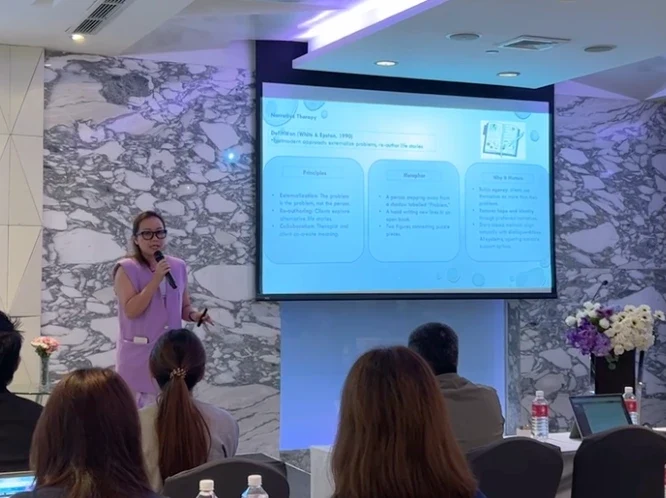
Pair Ungkana Kerttongmee presenting to an audience in a meeting room, with a slide on narrative therapy on the screen behind.
Presenting my doctoral research.

Research B · Visiting researcher

University of Oulu, Finland

ACMod: Affective Computing Models, from Facial Expression to Mind-Reading

As a visiting researcher at the University of Oulu, I am participating in the international ACMod research environment, which explores affective computing, emotional expression, emotion modelling and human–AI interaction.

This experience provides opportunities for interdisciplinary learning and collaboration at the intersection of psychology, human behaviour and AI.

My doctoral project is separate work and is not an official ACMod deliverable.

Research A in detail

Clinical Knowledge-Guided Adaptive AI Interviews for Depression Screening

Ongoing researchNon-diagnostic research

Some AI conversational systems choose their next question by statistical pattern alone, which can make it hard to explain why a question was asked or whether enough evidence has been gathered. This project explores a different approach: using explicit, auditable clinical knowledge to guide what is asked next.

  • PHQ-9 and DSM-5-informed knowledge framework

    A structured knowledge base derived from established depression-related instruments and diagnostic criteria, used as the reference for what an interview needs to cover.

  • Adaptive question selection

    Follow-up questions are chosen according to what is still missing or unclear, rather than following a fixed script.

  • Evidence completeness and explainability

    The system tracks what evidence has been gathered and can show why a question was asked, so a person can review its reasoning.

  • AI reflective listening

    The conversational layer aims to respond with warmth and reflective listening, while question selection remains rule-governed and inspectable.

  • Optional participant self-reflection

    Participants may optionally reflect on their own responses, supporting engagement and agency.

  • Safety escalation and clinician handoff

    Risk signals are designed to trigger escalation to a human, and the interview is designed to hand over to a clinician rather than act as one.

Status, methods and future evaluation

  • Status: in design and early development. No study results have been published.
  • Methods: knowledge-guided planning, simulated interviews and expert review are planned as early evaluation steps.
  • Future evaluation: any study involving real participants would require appropriate ethical approval and clinical oversight before it begins.

Publications and collaborations

Verified publications will be listed here as they become available.

See Publications & CV →

Research collaboration

Interested in digital mental health, responsible AI, affective computing or related research? I welcome thoughtful collaboration.

Start an enquiry